Factory-direct high-precision thermoplastics engineered for commercial print farms, global brand distributors, and OEM industrial clients.
Understanding the structural chemistry, rheological advantages, and industrial demand driving bio-based elastomeric additive manufacturing.
Rubber PLA (Soft PLA / Flexible PLA) represents a significant materials-science breakthrough in bio-based additive manufacturing. Unlike conventional rigid Polylactic Acid (PLA) or petroleum-derived Thermoplastic Polyurethane (TPU), Rubber PLA is synthesized by grafting flexible bio-compatible elastomers into a high-purity PLA polymer backbone.
This proprietary formulation yields a material with Shore A 85A to 95A flexibility, high tear resistance, and outstanding elasticity, while preserving the user-friendly printability, low heat requirement, and non-toxic processing characteristics of classic PLA.
Traditional TPU filaments suffer from severe feeding friction, gear binding, stringing, and excessive hygroscopic moisture uptake. For industrial print farms operating both Bowden tube and direct-drive FDM printers, standard TPU often leads to high error rates and nozzle clogs.
Rubber PLA resolves these friction bottlenecks. Its modified flexural modulus provides sufficient column stiffness to prevent buckling inside feeder extruders while delivering soft, rubber-like compliance in finished parts.
As global regulations push enterprise procurement toward carbon neutrality, Rubber PLA provides a renewable alternative to fossil-based rubbers. Formulated from cornstarch and sugarcane derivatives, it meets key European and American environmental standards.
It produces zero toxic VOC emissions during extrusion, making it safe for indoor production environments, educational institutions, and healthcare prototyping labs.
Deconstructing the operational requirements of B2B buyers, OEM private-label brands, and high-volume industrial print operations seeking China suppliers.
Enterprise buyers operating massive 3D printing farms cannot tolerate melt-index variations or color shifts between production batches. Procurement heads search for direct manufacturers capable of providing continuous compounding stability.
Torwell Technologies operates 6 automated extrusion lines equipped with closed-loop dual-axis laser feedback systems, guaranteeing that every spool of Rubber PLA exhibits consistent thermal rheology and dimensional stability.
Distributors and brand owners require tailored retail solutions to dominate local market niches. Search intent centered around "China Rubber PLA Manufacturer" heavily prioritizes OEM flexibility.
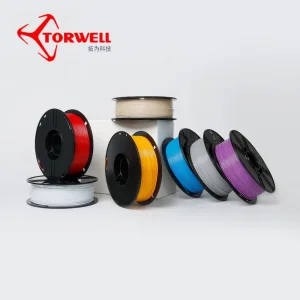
We provide full OEM turn-key support: Pantone-matched custom color formulation, flexible spool weights (250g, 500g, 1kg, 3kg, 5kg), eco-friendly cardboard or recycled plastic spools, and custom-branded nitrogen-vacuum sealed packaging.
Importing elastomeric filaments into Europe, North America, and East Asia demands strict adherence to chemical safety protocols.
All Torwell Rubber PLA and companion material series are fully certified under ISO9001 quality management standards, EU REACH, RoHS compliance, and FDA food-grade contact guidelines, mitigating regulatory risk for global importers.
Comprehensive quantitative comparison matrix for materials engineers and industrial procurement decision-makers.
| Material Property | Torwell Rubber PLA | Standard TPU (95A) | Traditional TPE | Standard PLA |
|---|---|---|---|---|
| Shore Hardness | 85A - 95A (Tunable) | 95A | 70A - 85A | 85D (Rigid) |
| Print Nozzle Temp. | 190°C – 220°C | 220°C – 245°C | 210°C – 230°C | 190°C – 210°C |
| Heated Bed Temp. | 0°C – 60°C | 50°C – 80°C | 40°C – 60°C | 50°C – 60°C |
| Print Speed Capability | 40 – 100 mm/s (High Speed) | 20 – 40 mm/s (Slow) | 15 – 30 mm/s (Very Slow) | 60 – 300 mm/s |
| Bowden Tube Feeder Success | High (Anti-Buckling) | Low / Moderate | Very Low | Excellent |
| Elongation at Break | > 350% | > 450% | > 500% | < 10% |
| Hygroscopic Sensitivity | Low (Minimal Moisture Grab) | High (Requires Active Drying) | Moderate to High | Low to Moderate |
| Odor & VOC Profile | Zero Toxic Odor (Bio-Based) | Slight Faint Odor | Slight Chemical Odor | Sweet Organic Odor |
Deploying flexible bio-elastomers across medical footwear, industrial automation, consumer electronics, and automotive engineering.
The podiatry and athletic footwear sectors are rapidly shifting toward custom additive manufacturing. Rubber PLA provides the ideal combination of soft heel cushioning, arch support stiffness, and breathable lattice printability.
Its bio-compatibility ensures safety for skin contact, while its high fatigue resistance guarantees long insoles life under cyclic walking loads.
Smart factories utilize Rubber PLA to produce custom robotic end-effector grippers, pneumatic suction pads, and anti-vibration dampening pads for assembly lines.
Its non-marring surface prevents scratching fragile electronic components during automated handling, offering a cost-effective quick-turn replacement for molded rubber parts.
Protective smartphone bumpers, smartwatch straps, drone shock mounts, and audio earbud fittings require materials with high impact absorption and smooth tactile skin feel.
Rubber PLA yields a refined matte-satin finish directly from the print bed, eliminating tedious post-processing sanding steps.
Automotive R&D centers use Rubber PLA for functional prototyping of door seals, dust boots, wiring harness grommets, and interior dampening sleeves.
Rapid iterative testing reduces vehicle component development cycles from months to days while lowering tooling expenditures.
Inside our 2,500 m² modern manufacturing hub: How continuous innovation guarantees zero-defect extrusion spools.
Virgin polymer pellets undergo twin-tower desiccant drying down to a moisture content below < 200 ppm prior to compounding, preventing hydrolytic polymer chain degradation during hot melt extrusion.
Co-rotating twin-screw extruders feature segmented temperature control zones, ensuring uniform dispersion of bio-elastomers, color pigments, and anti-aging stabilizers throughout the PLA matrix.
High-speed optical laser micrometers measure strand diameter and roundness in real-time at 500 Hz. Automatic puller speed adjustments maintain a strict ±0.02 mm tolerance limit.
Precision servo-spoolers stack filament in criss-cross orderly layers, eliminating criss-cross knots, tangles, and spool binding that cause unattended print failures.
Finished spools are immediately packed with active desiccant sachets inside thick multi-layer aluminum-barrier vacuum bags, preserving dryness during ocean transit.
Empowering global distributors with seamless logistics, international compliance certificates, and localized technical documentation.
We supply comprehensive Technical Data Sheets (TDS) and Safety Data Sheets (SDS) in English, German, French, Spanish, and Japanese, simplifying local market registration and industrial client onboarding.
With over 13 years of export experience to 75+ nations, Torwell handles full customs clearance, tariffs, and door-to-door delivery via sea container (FCL/LCL), air freight, or express courier.
Our material engineers provide direct technical support to assist your clients with printer profile optimization (Slic3r, Cura, Bambu Studio profiles), backed by a full batch replacement warranty.
Pioneering the next frontier of functional bio-elastomers and high-speed additive manufacturing materials.
As modern FDM 3D printers achieve speeds upwards of 500 mm/s, traditional soft materials lag behind. Torwell is formulating rapid-crystallization Rubber PLA variants optimized for high-throughput CoreXY printers.
Integrating carbon nanotubes and conductive nano-fillers into Rubber PLA matrix to enable 3D printed flexible sensors, wearable haptic circuits, and piezoresistive strain gauges.
Pushing the boundaries of softness toward 70A Shore hardness while maintaining structural column integrity during feeder gear engagement without nozzle clogging.
Detailed answers to fundamental questions regarding material specifications, printing guidelines, OEM ordering, and global shipping.
Rubber PLA is a bio-based modified polylactic acid alloy, whereas standard TPU is a synthetic petroleum-derived polyurethane. Rubber PLA prints at lower temperatures (190°C–220°C), emits zero toxic fumes, exhibits significantly higher resistance to moisture absorption, and is easier to print on Bowden-style extruders due to its unique flexural column stiffness. TPU offers slightly higher tear elongation but requires higher print temperatures and stringent active drying.
Yes! One of the major engineering breakthroughs of Torwell Rubber PLA is its anti-buckling feeding characteristics. Standard soft TPE/TPU often coils and jams inside PTFE Bowden tubes. Rubber PLA maintains sufficient column rigidity under pushing force, allowing smooth, continuous extrusion on both Bowden and Direct-Drive FDM 3D printers.
For optimal results, we recommend: Nozzle Temperature: 190°C – 220°C; Heated Bed Temperature: 40°C – 60°C (or unheated with blue painter's tape/PEI sheet); Print Speed: 30 – 80 mm/s; Retraction Distance: 2 – 4 mm for Direct Drive (4 – 6 mm for Bowden); Retraction Speed: 30 – 45 mm/s; Cooling Fan: 100% after layer 2.
Our standard MOQ for private-label OEM orders is 100 spools per customized SKU/color. For standard stock colors in Torwell unbranded or standard packaging, we accept trial orders starting at 20 spools. Bulk container discounts apply for 20ft and 40ft FCL orders.
Every extrusion line in our 2,500 m² plant is integrated with dynamic dual-axis laser micrometers that scan strand diameter and ovality at 500 measurements per second. If any section exceeds ±0.02 mm, an automated closed-loop feedback mechanism adjusts haul-off speed instantaneously, and out-of-spec segments are automatically flagged and segregated.
Yes. Rubber PLA utilizes renewable plant starches (corn and sugarcane) as its primary chemical feedstocks. It conforms to industrial composting standards, reducing long-term plastic waste accumulation compared to traditional non-degradable petroleum rubbers.
We provide full customization: Spool Net Weight: 250g, 500g, 1kg, 3kg, 5kg; Spool Materials: Transparent PC, Black ABS, Recycled Plastic, or Eco Cardboard; Outer Packaging: Custom printed color boxes with your brand logo, barcode labels, outer master cartons, and vacuum bags with custom desiccant branding.
When stored in its original unopened vacuum-sealed packaging at temperatures below 30°C (86°F) out of direct sunlight, Torwell Rubber PLA has an official shelf life of 24 months with zero property degradation.
All materials produced at Torwell Technologies comply with EU REACH regulation (EC No 1907/2006), RoHS directive (2011/65/EU & 2015/863), ISO 9001:2015 Quality Management Systems, and FDA 21 CFR 177.1520 food-contact safety standards.
You can request a free B2B sample kit by contacting our export sales desk via email ([email protected]) or submitting an inquiry directly through our online catalog portal. Samples are dispatched within 48 hours with full TDS support.
Discover companion materials including PLA+, Silk PLA, PETG, ABS, and Ultra-Flexible TPU series.
Ready to elevate your brand with high-performance Rubber PLA and factory-direct supply stability? Contact our engineering team today for custom quotes, technical specifications, and evaluation sample spools.
Request Wholesale Product Catalog & Samples