Precision-extruded thermoplastic formulations optimized for high-speed desktop and industrial FDM printing.
Analyzing global market dynamics, co-extrusion thermodynamics, and polymer modification in China's manufacturing ecosystem.
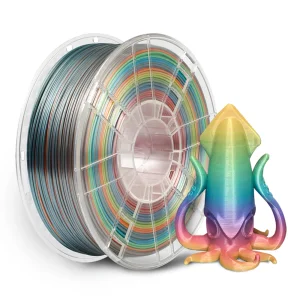
The global Fused Deposition Modeling (FDM) additive manufacturing sector has undergone a structural transition from purely utilitarian prototyping toward aesthetic consumer products, architectural modeling, visual media props, and customized merchandise. Within this shift, Rainbow PLA 1.75mm filament has established itself as a fast-growing specialty segment. Buyers across North America, Europe, and the Asia-Pacific region demand multi-color gradient filaments that offer smooth transition lengths, vibrant color saturation, and zero layer-delamination risks.
China has consolidated its position as the premier manufacturing hub for 3D printer filaments, housing advanced polymer synthesis facilities and precision extrusion line manufacturers. Chinese suppliers leverage integrated supply chains—from raw biopolymer synthesis to specialized masterbatch formulation—allowing them to offer unmatched cost efficiency, batch consistency, and OEM customization capabilities for global brands and distributors.
Standard Polylactic Acid (PLA) is a aliphatic polyester derived from renewable plant starches such as cornstarch or sugarcane. While neat PLA offers low thermal shrinkage and minimal warping, creating a high-performance Silk Rainbow PLA requires sophisticated polymer compounding:
Inferior gradient filaments rely on surface-dying or unstable single-screw color switching, which causes color bleed, thermal degradation, and structural layer weakness. Leading Chinese factories utilize multi-manifold co-extrusion technology. By feeding distinct color-matched PLA melts into a central mixing die under dynamic temperature control, we achieve seamless color transitions over defined length intervals (e.g., 3-5 meters per color shift) while maintaining absolute polymer homogeneity across the cross-sectional area.
Comprehensive physical, thermal, and mechanical parameters defining China Rainbow Filament 1.75 PLA production.
Extrusion lines are retrofitted with dual-axis inline laser micrometers checking diameter and ovality 500 times per second. Any spool exceeding ±0.02mm is automatically rejected.
Optimized melt-viscosity index allows consistent flow at printing speeds exceeding 300–500 mm/s on modern CoreXY printers (Bambu Lab, Voron, Creality K1 series) without stringing.
Fully automated servo-driven winding units maintain constant pitch and layer tension, eliminating cross-overs and tangles that lead to print job failure.
| Material Property | Test Standard / Method | Typical Value (Rainbow PLA 1.75mm) |
|---|---|---|
| Filament Diameter & Tolerance | Dual-Axis Laser Micrometer | 1.75 mm ± 0.02 mm (Ovality ≤ 0.01 mm) |
| Density | ISO 1183 / ASTM D792 | 1.24 g / cm³ |
| Melt Flow Index (MFI) | ISO 1133 (210°C / 2.16 kg) | 9 – 14 g / 10 min |
| Tensile Strength (Yield) | ISO 527 / ASTM D638 | 58 – 65 MPa |
| Flexural Modulus | ISO 178 / ASTM D790 | 2,450 – 2,800 MPa |
| Impact Strength (Izod Notched) | ISO 180 (23°C) | 4.5 – 6.0 kJ / m² |
| Glass Transition Temperature ($T_g$) | DSC (10°C / min) | 57°C – 61°C |
| Vicat Softening Temperature | ISO 306 (A50) | 58°C |
| Recommended Nozzle Temp | FDM Printing Test | 190°C – 225°C (Speed dependent) |
| Recommended Bed Temp | PEI / Glass Plate | 45°C – 60°C (Glue stick optional) |
Why sourcing directly from verified Chinese PLA suppliers optimizes profitability and product reliability.
Established Chinese manufacturers maintain direct procurement agreements with top-tier biopolymer resin producers. Purchasing bulk resin pellets in multi-ton quantities shields downstream OEM clients from market price volatility while ensuring uncompromised polymer purity.
Standard rainbow filaments shift colors every 10–15 meters, which works well for large models but leaves small parts single-colored. China's top factories offer customizable transition lengths (Fast-Change Rainbows with 3–5m transitions vs. Soft-Change Rainbows with 15–20m transitions) and custom Pantone palette development.
Complete turn-key private label solutions are supported: custom-printed corrugated boxes, cardboard spools (reducing plastic waste), QR-coded spool stickers for AMS automatic filament detection, and moisture-proof vacuum bags.
Unlocking commercial value across diverse creative and commercial sectors using Rainbow PLA 1.75mm.
Design studios use rainbow gradient PLA to highlight topographical changes, massing studies, and structural elevations without manual painting.
Vibrant silk finishes eliminate post-processing steps for prop makers, action figure designers, and fantasy tabletop gaming terrain.
Non-toxic, low-odor bio-based PLA is ideal for classroom environments. Multi-color visual feedback increases student engagement during CAD design projects.
Product designers evaluate tactile feel, aesthetic appeal, and shell geometry on consumer electronics prototypes before committing to injection molds.
Rigorous quality management systems guaranteeing market compliance across international borders.
Our Rainbow PLA 1.75mm formulations strictly adhere to international environmental and safety protocols:
PLA is hygroscopic and hydrolyzes when exposed to humidity, causing stringing and brittleness. Every spool undergoes a strict 4-step preservation protocol:
Next-generation material science advancements shaping the future of rainbow PLA extrusion.
Developing dynamic micro-injection nozzles capable of altering color gradients within less than 1 meter of filament travel for ultra-detailed small prints.
Integrating up to 50% post-industrial PLA waste stream into the core of rainbow filaments while maintaining flawless outer color layer integrity.
Combining silk gradient aesthetics with temperature-sensitive pigments (color changes at 31°C) or UV light absorption for interactive prints.
Addressing technical inquiries from B2B buyers, distributors, and engineering teams.
Explore our extended range of high-durability, flexible, and engineering-grade 3D printing polymers.