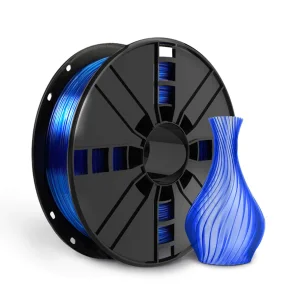
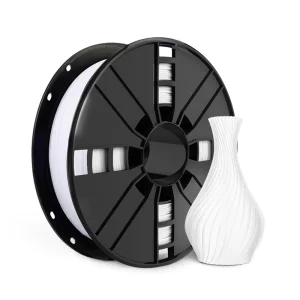
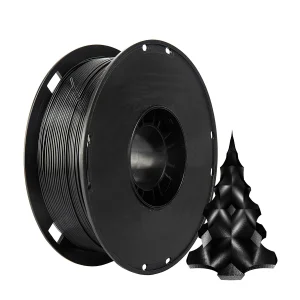
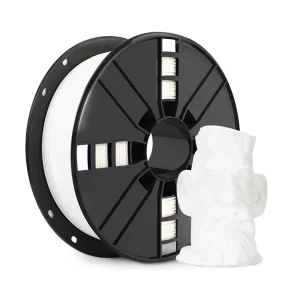
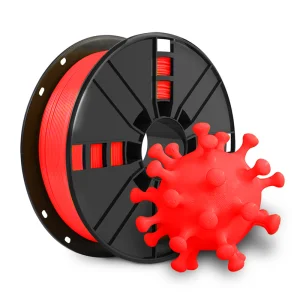
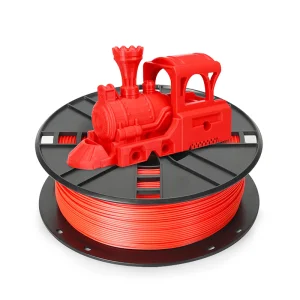
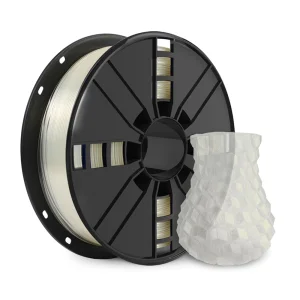
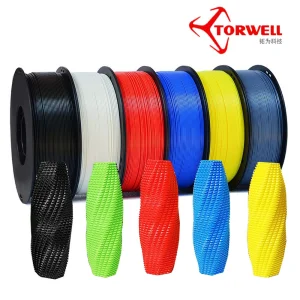
Explore our factory-direct bulk spool range engineered with ±0.02 mm diameter tolerance and low-warp thermal stability.
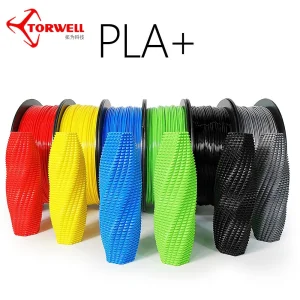
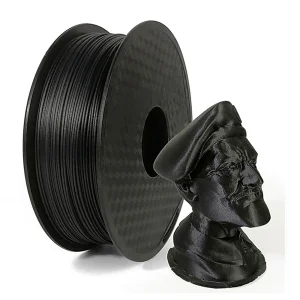
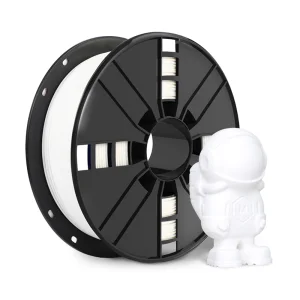
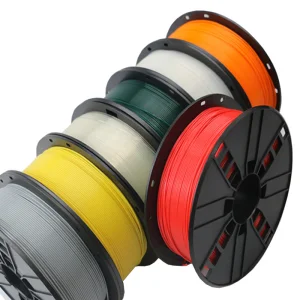
Understanding the molecular dynamics, glass transition temperature (Tg), and thermal deflection parameters that define enterprise-grade PC filament manufacturing in China.
Polycarbonate is an amorphous thermoplastic resin composed of bisphenol A connected by carbonate groups. In Fused Deposition Modeling (FDM) extrusion, virgin PC polymer chains require ultra-precise thermal profiling. Unlike crystalline polymers (such as PLA or PE), PC does not possess a sharp melting point. Instead, it transitions smoothly past its glass transition temperature (~145°C–150°C), demanding nozzle temperatures between 260°C and 310°C to achieve optimal melt flow index (MFI).
At Torwell’s manufacturing plant, raw PC resins undergo strict rheological testing to prevent thermal shear degradation during single-screw extrusion, preserving the resin's intrinsic impact resistance and optical clarity.
Polycarbonate is extremely hygroscopic, quickly absorbing moisture from ambient air. When wet PC resin enters an extrusion barrel, water molecules react with the ester bonds at high temperatures—a process known as hydrolytic degradation. This causes chain scission, resulting in brittle printed parts, excessive nozzle popping, heavy stringing, and catastrophic reduction in tensile strength.
Our China manufacturing facility employs closed-loop desiccant rotor dehumidification systems, drying virgin PC resin down to less than 0.02% moisture content prior to extrusion. Finished spools are immediately vacuum-sealed inside high-barrier aluminum-foil packaging with heavy-duty desiccant packs.
Why additive manufacturing leaders worldwide rely on polycarbonate and PC-alloy composite materials for structural end-use components.
Engineers utilize PC and PC-ABS filaments for under-the-hood enclosures, light pipes, interior mounting brackets, and battery housing modules where continuous heat exposure up to 110°C is required without dimensional deformation.
Offering superior dielectric strength and impact resistance, PC is the gold standard material for circuit breaker covers, electrical junction boxes, transparent protective shields, and outdoor NEMA-rated sensor enclosures.
Carbon fiber modified PC (PC-CF) delivers high stiffness-to-weight ratios for lightweight UAV frames, internal ducting, and protective covers capable of withstanding extreme mechanical shocks during operation.
| Material Grade | Tensile Strength (MPa) | Heat Deflection (HDT @ 0.45MPa) | Impact Strength (Izod J/m) | Warping Tendency | Primary Industrial Fit |
|---|---|---|---|---|---|
| Torwell Pure Polycarbonate (PC) | 68 – 72 | 138°C – 142°C | 850 J/m | High (Requires Enclosure) | Structural Housings, High-Heat Fixtures |
| PC-ABS Alloy | 55 – 60 | 110°C – 115°C | 650 J/m | Moderate | Automotive Trim, Functional Prototypes |
| PC Carbon Fiber (PC-CF) | 75 – 85 | 145°C – 150°C | 400 J/m | Very Low | Robotics Arms, Drone Chassis, Jigs |
| Torwell Engineering ABS | 40 – 45 | 92°C – 98°C | 220 J/m | Moderate to High | Consumer Electronics, Machined Accessories |
| Torwell High Toughness PETG | 48 – 52 | 70°C – 75°C | 90 J/m | Low | Chemical Tanks, Ducting, Daily Prototypes |
How Torwell Technologies leverages advanced automation, bulk polymer sourcing, and strict quality assurance to serve 75+ global markets.
Filament diameter variance is the primary cause of FDM print failure, leading to nozzle clogging (over-extrusion) or weak layer bonds (under-extrusion). Every production line at our 2,500 m² factory is equipped with high-speed dual-axis laser measurement sensors scanning at 500 Hz.
This continuous real-time feedback loop automatically adjusts extruder puller speeds, guaranteeing that 1.75mm and 2.85mm PC filaments maintain an absolute tolerance of ±0.02 mm across entire 1kg, 2.5kg, and 5kg spools.
Situated within China’s major polymer manufacturing corridor, Torwell maintains direct partnerships with global raw material chemical giants (including Covestro, SABIC, and Wanhua). This upstream integration provides us with consistent, prime-grade polycarbonate resins free from recycled contamination.
With 6 automated high-speed extrusion lines operating around the clock, our monthly output reaches 50,000kg to 60,000kg, enabling fast lead times, custom masterbatch color matching, and container-load pricing for international distributors.
Custom Pantone, RAL, or physical sample optical color matching for branded PC lines.
Standard plastic spools, high-temp ABS spools, or eco-friendly cardboard spools from 250g to 5kg.
Fully custom die-cut cardboard boxes, barcode integration, and multi-language user manuals.
Complete SDS, RoHS, REACH certifications provided with sea, air, and DDP shipping support.
How Torwell Technologies is advancing 3D polymer science to meet the demands of high-speed CoreXY 3D printers and green manufacturing standards.
Developing low-shear-thinning polycarbonate polymers engineered for 300mm/s to 500mm/s printing speeds on modern high-speed CoreXY machines without compromising inter-layer adhesion strength or thermal deflection limits.
Integrating chemical-recycling monomer feedstocks into PC polymer formulations, lowering Scope 3 carbon footprint for European and North American enterprise buyers seeking ESG-compliant industrial materials.
Formulating halogen-free, non-toxic flame-retardant PC and PC-CF composites certified to UL94-V0 standards for direct use in mass transit, aerospace interiors, and commercial electronic enclosure fabrication.
Operational parameters derived from Torwell’s R&D testing lab to ensure zero-defect prints across enterprise FDM equipment.
Polycarbonate prints can retain internal residual stresses created by rapid cooling. To achieve maximum mechanical yield strength and heat deflection performance:
Torwell Technologies adheres to international manufacturing protocols, supporting enterprise clients across North America, Europe, Asia-Pacific, and South America.
All raw polymers, color pigments, and functional additives used in Torwell PC filament production are rigorously tested to comply with EU REACH regulations and RoHS heavy-metal restrictions.
From raw batch inspection to final spool vacuum sealing, every manufacturing stage follows strict ISO 9001 certified protocols, complete with full batch traceability records.
We provide flexible logistical solutions including EXW, FOB, CIF, and DDP (Delivered Duty Paid) door-to-door freight by ocean, air, and express rail directly to your distribution hub.
Factory-direct supply for global distributors, Amazon sellers, and high-volume 3D printing farms.
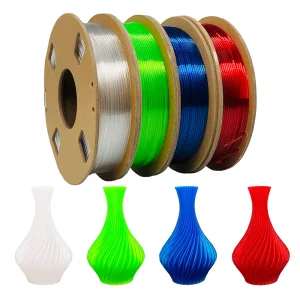
Detailed answers to critical technical, wholesale, and OEM questions for international material buyers.