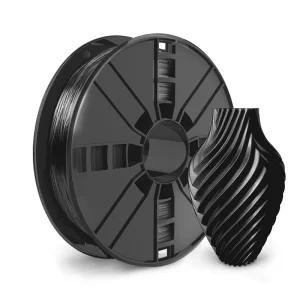
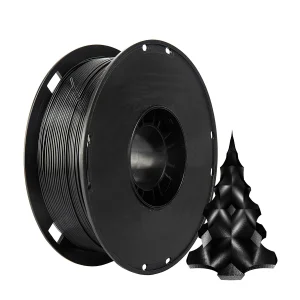
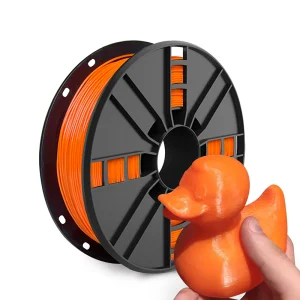
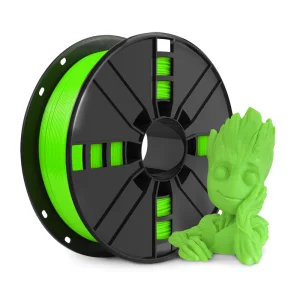
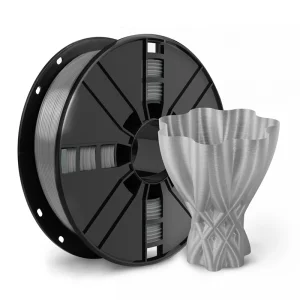
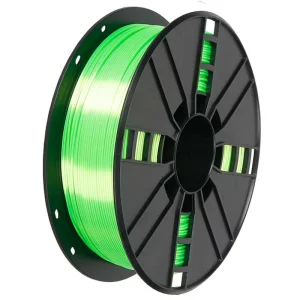
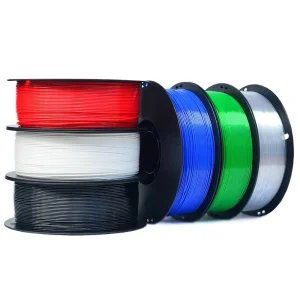
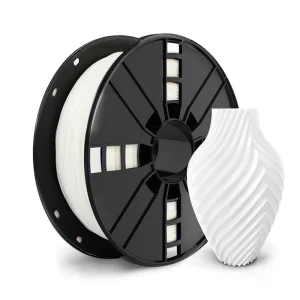
Direct factory supply of precision spooled 3D printer filaments for enterprise OEM brands, regional wholesale distributors, and industrial additive manufacturing facilities.
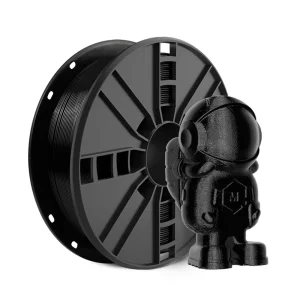
Analyzing the industrial transition from cosmetic prototyping to functional end-use polymer components in aerospace, automotive, and heavy machinery tooling.
The global additive manufacturing sector is experiencing a structural paradigm shift. As Fused Deposition Modeling (FDM) and Fused Filament Fabrication (FFF) technologies mature, enterprise procurement requirements have evolved beyond aesthetic prototyping resins like standard PLA. Modern engineering buyers are demanding load-bearing thermoplastic filaments with exceptional tensile strength, flexural modulus, chemical inertness, and thermal endurance. At the forefront of this industrial material evolution stands Nylon (Polyamide) filament.
Unreinforced Polyamide (PA6 and PA66) is rapidly being augmented by short-carbon fiber (PA-CF) and glass-fiber (PA-GF) filled matrices. These fiber-reinforced composite filaments drastically reduce anisotropic shrinkage, eliminate bed warping, and elevate structural stiffness to match metal die-cast aluminum parts.
With Next-Gen core-XY 3D printers operating at speeds between 300 mm/s and 600 mm/s, Nylon formulations require fine-tuned melt flow index (MFI) characteristics. Leading China Nylon filament factories utilize customized rheology modifiers to ensure rapid thermal dissipation and flawless inter-layer adhesion under extreme extrusion volumetric rates.
Environmental compliance regulations across Europe and North America (such as ESG mandates and carbon footprint tracking) are accelerating demand for bio-based Polyamides derived from renewable castor oil (PA11 and PA610), offering superior moisture resistance and a lower cradle-to-gate carbon footprint.
What Fortune 500 procurement managers, tier-1 automotive suppliers, and defense contractors demand when qualifying a China Nylon Filament Manufacturer.
Polyamide is inherently hygroscopic and challenging to extrude with strict geometric tolerances. Global buyers enforce inline dual-axis laser micro-gauge monitoring that tracks diameter variations within a strict ±0.02 mm margin. Ovality (ellipticity) must not exceed 1% to prevent heat-break jams, under-extrusion, or gear slip inside automated direct-drive extruders and AMS (Automatic Material Systems).
Nylon's amide functional groups (-NH-CO-) form strong hydrogen bonds with ambient water molecules. Extruding moist filament causes steam micro-explosions, severe void formation, surface blistering, and up to 60% degradation in Z-axis tensile strength. Enterprise procurement requires factories to run continuous closed-loop dehumidifying desiccant air dryers (<0.02% residual moisture) prior to hermetic aluminum foil vacuum sealing with industrial desiccants.
For industrial print farms operating hundreds of machines, consistency is paramount. A variation of 2 g/10min in Melt Flow Index (MFI) between production lots forces re-calibration of slicing profiles, leading to costly machine downtime. Professional manufacturers implement rigorous raw resin QA via Differential Scanning Calorimetry (DSC) and Melt Flow Indexing according to ASTM D1238 standards.
Seamless international customs clearance requires complete regulatory documentation. High-tier China manufacturing facilities provide RoHS 3.0, REACH (SVHC), UL94-V0 flammability certificates, halogen-free test reports, and ISO 9001:2015 quality control compliance to simplify OEM brand integration into North American and European retail ecosystems.
When selecting a factory supply partner for Polyamide filaments, ask for ISO 527 (Tensile Test) and ISO 178 (Flexural Test) raw data sheets. Unannealed versus post-annealed specs should be clearly documented. True industrial-grade Nylon 6/66 compounds must show flexural modulus values exceeding 6,500 MPa when loaded with 20% to 30% micro-chopped carbon fibers.
How China's centralized chemical clusters and automated extrusion technology deliver unprecedented cost efficiency, material stability, and rapid OEM scaling.
China has established itself as the world's leading hub for 3D printing filament production, driven by a complete upstream chemical supply chain, skilled materials science engineers, and advanced Industry 4.0 manufacturing infrastructure. Sourcing from a specialized China Nylon Filament Factory grants international buyers a distinct structural cost advantage alongside uncompromising quality standards.
China hosts the world’s largest synthesis bases for Caprolactam (Nylon 6 precursor), Hexamethylenediamine, and Adipic Acid (Nylon 66 precursors). Direct proximity to premier resin refiners eliminates international logistics surcharges on raw polymers, securing ultra-competitive B2B pricing even during global raw material fluctuations.
Modern Chinese factories utilize custom multi-zone twin-screw compounding extruders outfitted with gravimetric loss-in-weight feeders. This guarantees exact filler loading (e.g., exactly 20.0% carbon fiber by weight) and flawless pigment distribution, preventing structural hot spots or nozzle-clogging agglomerates.
From custom Pantone color matching to private label spool design, automated laser-printed weight markings, QR code batch tracing, and eco-friendly cardboard spools—China’s agile manufacturing ecosystems enable global distributors to launch custom SKUs in as little as 14 days.
Understanding the molecular dynamics and mechanical trade-offs between PA6, PA66, PA12, and advanced fiber-reinforced composites.
Key Characteristics: High impact resistance, excellent mechanical strength, superior fatigue resistance, and exceptional chemical tolerance to oils, fuels, and organic solvents.
Primary Applications: Functional automotive components (under-the-hood brackets, intake manifolds), custom manufacturing jigs, assembly fixtures, and heavy-duty mechanical gears.
Key Characteristics: Lower moisture absorption compared to PA6, outstanding dimensional stability, superior chemical resistance, and lower thermal processing temperatures.
Primary Applications: End-use fluid conduits, pneumatic tubing, outdoor sports equipment, drone frames, and precision electronic enclosures exposed to humid environments.
Key Characteristics: Incorporates 15%–30% high-modulus chopped carbon fibers. Features extremely high tensile strength (>110 MPa), negligible warping, high stiffness, matte black surface finish, and elevated Heat Deflection Temperature (HDT up to 185°C).
Primary Applications: Aerospace ducting, racing drone arms, robotic end-effectors, replacement of CNC machined aluminum components, and metal stamping dies.
Key Characteristics: High compressive strength, superior electrical insulation properties, high heat resistance, and excellent dimensional tolerance under sustained static loading.
Primary Applications: Electrical junction boxes, power tool housings, high-voltage isolators, and industrial pump impellers requiring structural rigidity without carbon electrical conductivity.
Comparative mechanical metrics evaluating pure and reinforced Nylon grades against standard industrial thermoplastics (ASTM/ISO Test Standards).
| Material Grade | Tensile Strength (MPa) | Flexural Modulus (MPa) | Heat Deflection Temp (°C @0.45MPa) | Water Absorption (24h Saturation %) | Recommended Nozzle Temp (°C) |
|---|---|---|---|---|---|
| Standard PA6/66 | 65 – 75 | 2,100 – 2,500 | 90 – 110 | 1.2% – 1.8% | 250 – 275 |
| Industrial PA12 | 50 – 60 | 1,600 – 1,900 | 85 – 95 | 0.2% – 0.4% | 240 – 260 |
| PA-CF20 (20% Carbon Fiber) | 105 – 125 | 6,800 – 7,500 | 175 – 190 | 0.5% – 0.7% | 270 – 300 |
| PA-GF25 (25% Glass Fiber) | 85 – 100 | 4,500 – 5,200 | 150 – 165 | 0.6% – 0.8% | 265 – 290 |
| Industrial PETG | 45 – 50 | 1,900 – 2,100 | 70 – 75 | 0.1% – 0.2% | 230 – 250 |
| High-Impact ABS | 40 – 48 | 2,000 – 2,300 | 85 – 92 | 0.2% – 0.4% | 240 – 265 |
To achieve maximum mechanical performance from printed Nylon parts, perform post-print annealing in a vacuum oven at 80°C–90°C for 4 to 6 hours. This process increases polymer crystallinity, eliminates internal residual stress from layer cooling, and can boost inter-layer (Z-axis) shear strength by up to 35%.
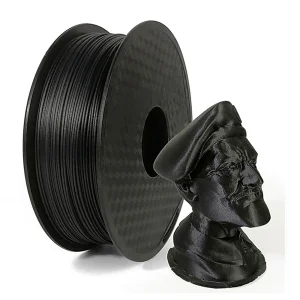
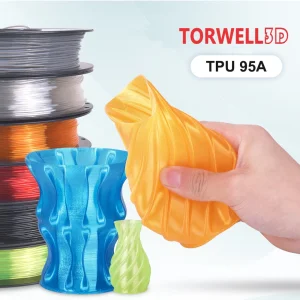
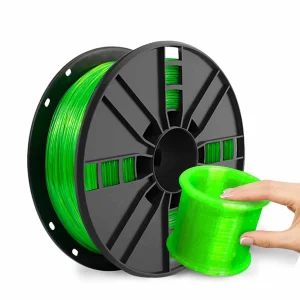
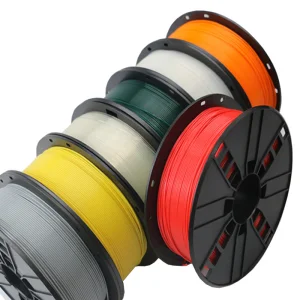
Factory-direct inventory spanning specialized engineering blends, high-aesthetic silk PLA, tough PETG, and flexible TPU spools.
Essential technical and logistical insights for global distributors, OEM partners, and industrial procurement agents.