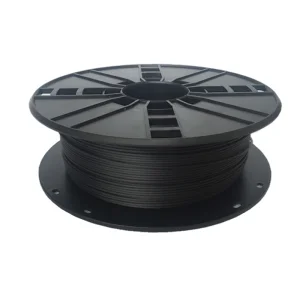
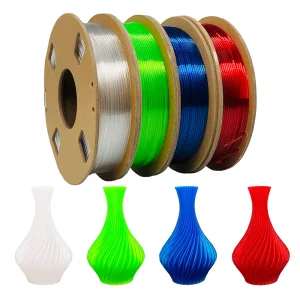
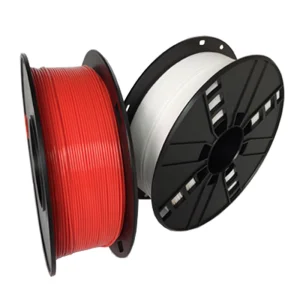
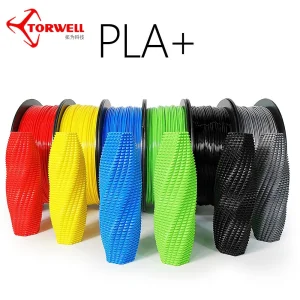
Precision-extruded polymer spools engineered with ±0.02mm laser tolerance control for global distributors and large-scale print farms.
Understanding the terpolymer matrix of Acrylonitrile Butadiene Styrene and the pigment dispersion dynamics required for high-speed, zero-yellowing industrial 3D printing.
ABS is synthesized from three monomers: Acrylonitrile (25-30%) for chemical resistance and thermal stability, Butadiene (15-20%) for impact strength and low-temperature toughness, and Styrene (50-55%) for rigidity and surface gloss. Precision ratio tuning ensures structural integrity under mechanical stress.
Formulating pure white ABS requires rutile phase titanium dioxide ($TiO_2$) particles coated with inorganic alumina and silica. This structure mitigates photocatalytic degradation, maintaining a low Yellowing Index ($YI < 1.2$) during repeated thermal cycles up to 260°C.
Targeting a Melt Flow Index (MFI) of 12–15 g/10min (220°C/10kg) guarantees ideal shear-thinning characteristics. The filament flows seamlessly through 0.4mm micro-nozzles while retaining structural viscosity to prevent overhang sag and layer delamination.
China's unified polymer supply chain infrastructure combines raw resin production, precision tooling, laser gauging, and containerized logistics into an unbeatable value proposition for OEM brand owners and high-volume purchasers.
China’s manufacturing clusters in Guangdong and Jiangsu sit directly adjacent to tier-1 polymer suppliers (e.g., Chimei POLYLAC®, LG Chem). This direct sourcing ensures lot-to-lot resin purity, eliminating scrap contamination and securing preferential raw material pricing that directly lowers buyer cost-per-spool.
Modern Chinese factories employ automated extrusion lines equipped with 100Hz dual-axis laser calipers. Real-time feedback loops automatically adjust tractor speed to hold a strict ±0.02mm diameter tolerance and keep ovality under 1%, virtually eliminating nozzle clogs and extruder grinding.
Tangling is a major point of failure for end users. China's automated spooling cells utilize CNC tension controllers to guarantee neat, side-by-side layer wrapping. Spools are immediately vacuum-sealed with high-absorption silica gel packs, maintaining moisture levels below 0.05% during transoceanic shipping.
We support customized Pantone whiteness matching (RAL 9010 / RAL 9016), custom spool designs (cardboard or plastic), custom vacuum bags, and branded retail cartons.
Request OEM Factory QuotationThe rapid rise of high-speed FDM printers (300mm/s–600mm/s) is accelerating innovation in thermoplastic compounding, low-warp chemistry, and eco-conscious packaging.
Standard ABS filaments suffer layer separation when printed at speeds above 150mm/s due to inadequate thermal heat transfer. Next-gen White ABS incorporates melt-strength enhancers and nucleating agents that increase thermal conductivity, enabling solid layer bonding at speeds exceeding 400mm/s.
By grafting small fractions of styrene-acrylonitrile-maleic anhydride (SAN-MAH) or blending micro-amounts of polycarbonate (PC), factory engineers reduce the volumetric thermal expansion coefficient of ABS. This drastically cuts part warping and corner lifting without sacrificing impact resistance.
Volatile organic compound (VOC) emissions, particularly residual styrene monomer gases, have historically limited indoor ABS usage. Modern Chinese extrusion plants utilize multi-stage vacuum degassing twin-screw extruders to strip unreacted monomer volatiles below 50 ppm, satisfying strict indoor air quality norms (ISO 16000-6).
White ABS 1.75mm is the benchmark material for functional prototyping, end-use electrical enclosures, and high-contrast master patterns across key global manufacturing sectors.
White ABS is extensively utilized for interior automotive verification—dashboard air vents, center console latches, and switch housing prototypes. Its high heat deflection temperature ($HDT > 85^\circ C$) allows functional parts to withstand hot-vehicle cabin testing without softening.
Appliance manufacturers rely on pure white ABS filament for prototyping medical device shells, air purifier frames, smart home sensors, and router housings. The clean RAL 9016 white finish offers accurate visual inspection and accepts surface sanding, painting, and vapor smoothing easily.
In automated assembly lines, custom white ABS end-effectors, inspection jigs, and robotic arm grippers provide structural rigidity while maintaining high visibility against dark metallic machinery. The material's impact strength absorbs repetitive assembly shocks.
Comparative laboratory benchmark data for engineering design selection. All measurements taken from standard ISO test bars extruded under factory quality control guidelines.
| Material Grade | Density (g/cm³) | Tensile Strength (MPa) | Flexural Modulus (GPa) | Izod Impact (kJ/m²) | HDT @ 0.45 MPa (°C) | Glass Transition (°C) | Shrinkage Rate (%) |
|---|---|---|---|---|---|---|---|
| ABS 1.75 White (Torwell Standard) | 1.04 | 43.5 | 2.25 | 18.2 | 88°C | 104°C | 0.4% - 0.7% |
| PLA 1.75 Pure White | 1.24 | 58.0 | 3.10 | 5.1 | 55°C | 60°C | 0.2% - 0.4% |
| PETG 1.75 White | 1.27 | 48.0 | 2.05 | 9.5 | 68°C | 78°C | 0.3% - 0.5% |
| ASA 1.75 Weatherproof White | 1.07 | 45.0 | 2.30 | 16.5 | 94°C | 105°C | 0.4% - 0.6% |
| PC/ABS High-Impact White | 1.12 | 54.0 | 2.45 | 38.0 | 102°C | 125°C | 0.5% - 0.8% |
*Note: Data values represent standard testing conditions (23°C, 50% RH). Exact technical data sheets (TDS) and safety data sheets (SDS) are provided with every batch shipment.
Eliminate warping, layer splits, and bed detachment by following our factory-tested parameter matrix for 1.75mm White ABS filament printing.
Maintain nozzle temperatures between 230°C and 250°C. Lower temperatures risk poor layer fusion and internal void formation, while excessive heat (>265°C) causes polymer degradation and yellowing of white pigments.
Keep the build plate at 95°C to 110°C. An enclosed chamber maintained between 45°C and 55°C is essential to equalize stress during part cooling and suppress thermal shrinkage stress vectors.
Utilize textured PEI spring steel sheets or apply a thin layer of ABS slurry (ABS scraps dissolved in pure acetone) onto glass beds. Turn off part cooling fans for the first 5 layers; cap cooling at 15–20% for severe overhangs only.
Addressing critical B2B sourcing inquiries, batch consistency standards, custom packaging services, and regulatory compliance.
While PLA prints easily, it softens at just 55°C and lacks impact toughness. White ABS offers a much higher Heat Deflection Temperature (HDT ~ 88°C), superior ductility, and the ability to undergo chemical post-processing such as acetone vapor smoothing to create injection-molded surface finishes. This makes ABS the material of choice for end-use functional testing and tough enclosure housings.
Yellowing during printing occurs due to thermal oxidation of un-stabilized styrene resin or cheap titanium dioxide pigment grades. We use 100% virgin resin compounded with primary phenolic antioxidants and secondary phosphite thermal stabilizers, paired exclusively with rutile-phase coated TiO₂. This preserves a bright white index ($YI < 1.2$) even under prolonged exposure to high extruder temperatures.
Our standard MOQ for stock color formulations is 100 spools per SKU. For custom OEM private label projects—including branded spools, custom color box printing, customized labels, and specific Pantone color matching (e.g., RAL 9010 pure white or RAL 9016 traffic white)—the typical MOQ is 500 to 1,000 spools, with complete flexibility for container-level bulk orders.
Each of our automated production lines integrates dual-axis laser micrometer gauges positioned immediately after the primary cooling bath. The laser gauge measures filament diameter across two axes at 100 cycles per second. If any deviation from 1.75mm occurs, the closed-loop system automatically modulates haul-off pulling speed to restore target dimensions instantly.
Prior to packaging, filament spools undergo a 6-hour inline desiccant dehumidification cycle until moisture content drops below 0.05%. Spools are immediately heat-sealed in heavy-duty 80-micron vacuum barrier pouches alongside high-capacity active silica desiccant packs. Pouch integrity is verified before packing into 5-ply reinforced master export cartons designed for humid sea freight conditions.
Yes. We supply comprehensive compliance dossiers for all white ABS filaments, including RoHS 2.0 (Directive 2011/65/EU), REACH (EC 1907/2006 SVHC candidate list), UL 94HB flammability ratings, and ISO 9001 certified manufacturing quality protocols necessary for customs clearance and retail distribution across North America, Europe, and Asia-Pacific.
Expand your product offering with our complete lineup of functional, engineering, and aesthetic 3D printing filaments manufactured under strict quality standards.