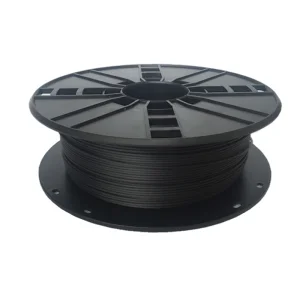
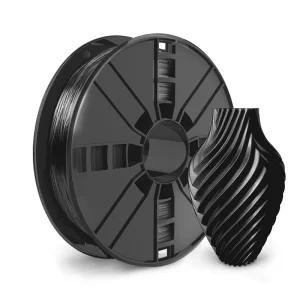
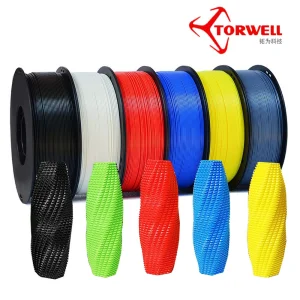
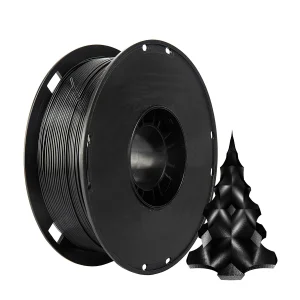
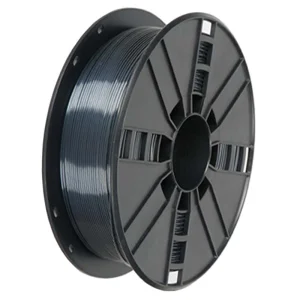
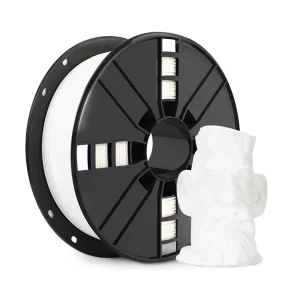
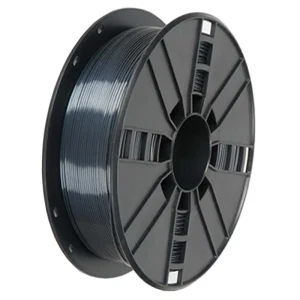
Acrylonitrile Butadiene Styrene (ABS) black monofilament represents one of the most vital thermoplastic building blocks in modern Fused Deposition Modeling (FDM) and Fused Filament Fabrication (FFF). As global manufacturing moves toward decentralized, print-farm-driven rapid tooling and functional end-use component fabrication, sourcing premium-grade ABS Black from China has evolved from a simple low-cost procurement decision into a strategic supply chain partnership.
Material Science Insight: ABS Black is a terpolymer synthesized by polymerizing styrene and acrylonitrile in the presence of polybutadiene. The chemical synthesis ratio—typically 25% Acrylonitrile for thermal and chemical resistance, 20% Butadiene for structural impact toughness, and 55% Styrene for rigidity and melt processability—determines the exact mechanical threshold of the extruded monofilament.
The manufacturing quality of ABS Black filament rests fundamentally on two pillars: masterbatch carbon black dispersion and thermal stabilization during twin-screw compounding extrusion.
Unprocessed carbon black particles naturally form micro-agglomerates that act as stress concentration sites, severely weakening layer adhesion. China’s leading factories employ high-shear co-rotating twin-screw extruders to achieve sub-micron dispersion, guaranteeing deep matte jet-black color without mechanical degradation.
High-speed 3D printing (exceeding 300 mm/s to 600 mm/s) requires precise melt rheology control. By calibrating the polymer's Melt Flow Rate (MFR: 12 to 19 g/10min at 220°C/10kg), our formulation ensures rapid shear thinning in the hotend nozzle followed by instantaneous structural recovery upon deposition.
Polybutadiene rubber phase is prone to thermo-oxidative crosslinking when held at elevated extrusion temperatures (230°C–260°C). Advanced hindered phenol antioxidants and phosphite secondary stabilizers are compounded into the matrix, preventing nozzle carbonization and thermal degradation during long print jobs.
Comprehensive material data verified through ISO and ASTM standardized laboratory testing procedures under controlled ambient environment (23°C, 50% RH).
| Physical / Mechanical Property | Testing Standard | Metric Benchmark Unit | Torwell ABS Black Grade |
|---|---|---|---|
| Monofilament Density | ISO 1183 / ASTM D792 | g/cm³ | 1.04 - 1.06 |
| Melt Flow Index (MFR 220°C/10kg) | ISO 1133 / ASTM D1238 | g / 10 min | 14.5 ± 2.0 |
| Tensile Strength at Yield (50mm/min) | ISO 527 / ASTM D638 | MPa | 45 - 50 |
| Flexural Modulus (2mm/min) | ISO 178 / ASTM D790 | MPa | 2,250 - 2,400 |
| Izod Notched Impact Strength (23°C) | ISO 180 / ASTM D256 | kJ/m² (or J/m) | 21.5 kJ/m² |
| Heat Deflection Temp (HDT @ 0.45 MPa) | ISO 75 / ASTM D648 | °C (Annealed) | 88°C - 95°C |
| Glass Transition Temperature (Tg) | DSC (10°C/min) | °C | 104°C |
| Linear Thermal Shrinkage Coefficient | ASTM D696 | 1/K | 8.0 × 10⁻⁵ |
| Monofilament Diameter Tolerance | Inline Dual-Axis Laser | mm | ±0.02 mm |
| Ovality Roundness Deviation | Interferometry Analysis | % | ≤ 1.0% |
Enterprise procurement departments, brand owners, and OEM distributors select China-manufactured ABS Black filament for mission-critical structural applications across multiple high-growth technology sectors.
Automotive tier-1 suppliers utilize ABS Black for functional prototyping of dashboard bezels, interior trim pieces, HVAC ducting assemblies, and specialized assembly jigs. The material's high Heat Deflection Temperature (HDT) enables parts to withstand elevated cabin and engine-bay ambient environments without thermal creep.
Deep black matte surface finishing masks layer-line artifacts, providing an injection-molded aesthetic directly off the build plate. Electronics OEMs deploy ABS Black for drone frames, handheld terminal housings, and custom anti-static (ESD-safe) electronic packaging enclosures.
Commercial print farms operating hundreds of coreXY automated printers require batch-to-batch consistency. Diameter deviations lead to extrusion starvation or over-extrusion clogging. Standardizing on Torwell's laser-monitored ABS Black drives part scrap rates down below 0.3%.
Robotic automation cells require lightweight yet rigid end-of-arm tooling (EOAT). ABS Black provides an optimal stiffness-to-weight ratio, allowing fast axis acceleration on industrial multi-axis robotic arms while maintaining high impact energy absorption.
To eliminate print defects such as bubbling, delamination, warping, and nozzle friction, every spool of ABS Black passes through a rigorous closed-loop quality control pipeline.
ABS polymer pellets are subjected to 4 hours of dehumidified hot air drying at 80°C down to <0.05% moisture content prior to melt extrusion.
Precision temperature zone control (Z1: 200°C to Z5: 245°C) preserves resin molecular weight while ensuring complete additive homogenisation.
Continuous 100Hz laser interferometers record X and Y axis diameter data. Any section exceeding ±0.02mm is automatically cut and segregated.
Automated servo-driven traverse spooling maintains uniform winding tension, guaranteeing zero crossover tangles across all 1kg and 3kg spools.
Immediate vacuum sealing in thick aluminum-foil moisture barrier packaging with concentrated silica gel guarantees shelf life during sea transit.
Torwell Technologies empowers global brands and industrial buyers with comprehensive private label manufacturing and full regulatory certification across international jurisdictions.
All ABS Black raw materials, color masterbatches, and processing aids comply fully with EU RoHS Directive 2011/65/EU & (EU)2015/863, REACH (EC 1907/2006 SVHC 235), and California Proposition 65 requirements.
Standard ABS Black meets UL94 HB horizontal burning ratings. Upon request, customized UL94 V-0 flame-retardant compounded ABS Black formulations are produced for specialized electronics housing projects.
Complete OEM customization including eco-friendly recycled cardboard spools, clear polycarbonate spools, customized Pantone box artwork, branded spool labels, and customized master carton packaging.
As 3D hardware evolves toward higher print speeds and elevated chamber temperatures, Torwell's R&D division continues to push the boundaries of styrenic polymer formulations.
Engineered with modified molecular weight distribution to maintain low viscosity at high shear rates, allowing clean melt delivery on modern high-speed printers without nozzle backpressure.
Reinforced with 15% weight chopped carbon fiber strands. Offers exceptional structural stiffness, virtually zero thermal shrinkage warping, and an ultra-luxurious textured matte black finish.
Formulated with 80% recycled post-consumer electronics housings. Re-stabilized with impact modifiers to deliver 92% of virgin ABS mechanical performance for circular economy goals.
In-depth answers to common material engineering, printing optimization, and OEM procurement inquiries regarding China ABS Black supply.