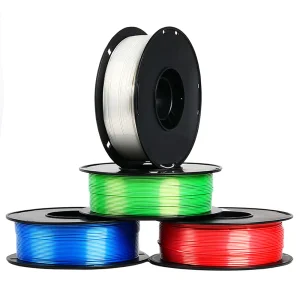
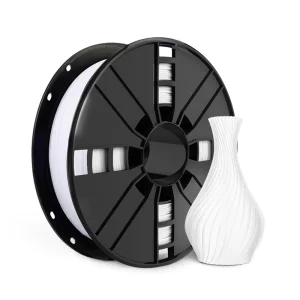
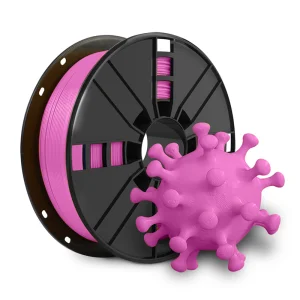
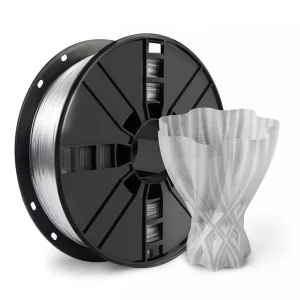
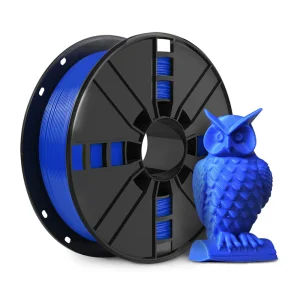
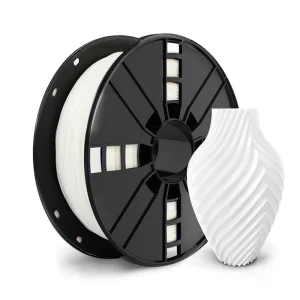
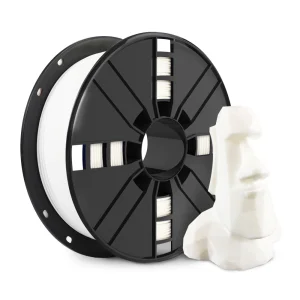
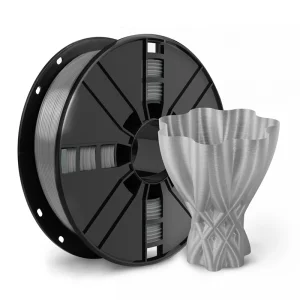
Precision-extruded spools tested for melt stability, zero bubble formation, and strict dimensional accuracy across international distribution networks.
In the realm of global industrial manufacturing, additive production has rapidly transitioned from cosmetic rapid prototyping to direct functional part manufacturing. Within this evolution, flexible polymers—specifically Thermoplastic Elastomers (TPE) and Thermoplastic Polyurethanes (TPU)—represent one of the fastest-growing categories in the fused deposition modeling (FDM / FFF) segment. Industrial procurement teams and brand distributors are increasingly seeking reliable wholesale TPE filament suppliers and factories capable of yielding strict batch-to-batch consistency, advanced mechanical dampening, and chemical resistance.
Historically, manufacturing rubber-like flexible components required expensive aluminum or steel injection tooling, liquid silicone rubber (LSR) processing, or compression molding equipment. These traditional methods demand high minimum order quantities (MOQs) and upfront capital expenditures ranging from $10,000 to over $50,000 per mold design. Direct additive manufacturing utilizing engineering-grade TPE filaments eliminates these financial barriers, enabling rapid iterations of custom gaskets, ergonomic grips, vibration isolators, and seals with zero tooling cost.
Bypass capital-intensive injection molding. Produce custom elastomeric seals, sleeves, and bellows directly from CAD files within hours instead of waiting weeks for tooling fabrication.
TPE formulations absorb high mechanical shocks, resist cyclical flex fatigue, and deliver dynamic rebound properties superior to rigid thermoplastics like PLA or ABS.
From ultra-flexible 60A durometers for soft grips to semi-rigid 95A compounds for protective housings, wholesale TPE suppliers provide calibrated durometers for any application.
SEO & Market Intelligence Note: The global 3D printing filament market is projected to expand at a CAGR of over 23.5% through 2030. Flexible elastomers (TPE/TPU) account for the highest demand surge in industrial automation, medical robotics, and consumer electronics due to their unique viscoelastic performance profile.
To make informed purchasing decisions, enterprise engineers and wholesale buyers must understand the microstructural distinctions between standard Thermoplastic Elastomers (TPE) and Thermoplastic Polyurethanes (TPU). While both fall under the broad umbrella of elastomeric block copolymers, their chemical backbones dictate vastly different printing characteristics, chemical resistance profiles, and mechanical behaviors under strain.
Thermoplastic Elastomers are typically synthesized as block copolymers combining hard matrix phases (which provide physical crosslinking, thermal stability, and tensile strength) with soft elastomeric segments (which deliver elasticity, low-temperature flexibility, and high elongation at break). The most prominent industrial TPE filaments rely on Styrene-Ethylene-Butylene-Styrene (SEBS) or Thermoplastic Vulcanizates (TPV) chemistry.
Because SEBS-based TPE contains non-polar hydrocarbon backbones, it exhibits exceptional resistance to water, polar solvents, dilute acids, and bases. Furthermore, SEBS exhibits a lower coefficient of surface friction compared to ester- or ether-based TPU, resulting in a tactile surface that is less sticky and less prone to surface abrasion in consumer-facing applications.
The primary challenge during FDM printing of low-durometer TPE filament (e.g., Shore 70A to 85A) is material column instability inside the extruder drive gear assembly—a phenomenon governed by Euler's Buckling Formula:
$$P_{cr} = \frac{\pi^2 E I}{(K L)^2}$$
Where $P_{cr}$ represents the critical buckling load, $E$ is the flexural modulus of the filament, $I$ is the area moment of inertia, and $L$ is the unconstrained length of filament between the drive gear nip point and the hot-end melt zone.
Because flexible TPE filaments possess a significantly lower flexural modulus ($E$) than rigid PLA or PETG, any unconstrained gap ($L$) in the filament path causes the strand to buckle, bend, and wrap around drive gears, bringing the print job to a halt. Premier OEM factories overcome this challenge through precise diameter tolerance control ($\pm0.02\text{ mm}$), uniform melt-flow index (MFI), and engineered surface lubrication that reduces feeding friction inside PTFE Bowden tubes and direct-drive hot ends.
Quantitative mechanical, thermal, and print performance parameters comparing industrial-grade TPE durometers against standard engineering thermoplastics.
| Material Grade | Shore Hardness | Tensile Strength (MPa) | Elongation at Break (%) | Nozzle Temp (°C) | Bed Temp (°C) | Chemical Resistance | Primary Industrial Use |
|---|---|---|---|---|---|---|---|
| Torwell TPE 70A | 70 Shore A | 14 - 18 | > 650% | 210 - 235 | 30 - 50 | High (Acids/Alkalis) | Soft Seals, Medical Liners, Grips |
| Torwell TPE 83A | 83 Shore A | 22 - 28 | > 550% | 215 - 240 | 40 - 60 | High (Water/Oils) | Vibration Dampeners, Gaskets |
| Torwell TPU 95A | 95 Shore A | 35 - 45 | > 450% | 220 - 245 | 50 - 70 | Moderate (Grease/Oils) | Protective Housings, Wheels, Belts |
| PLA+ Pro Grade | 80 Shore D | 55 - 65 | 6% - 12% | 190 - 220 | 40 - 60 | Low (Solvents) | High-Strength Rigid Prototypes |
| Engineering PETG | 78 Shore D | 45 - 52 | 15% - 25% | 230 - 250 | 70 - 80 | High (Chemicals/Water) | Enclosures, Structural Fixtures |
| Industrial ABS | 75 Shore D | 40 - 48 | 10% - 20% | 230 - 260 | 90 - 110 | Moderate (Hydrocarbons) | Automotive Trim, Tool Housings |
| Weather-Proof ASA | 76 Shore D | 42 - 50 | 12% - 18% | 240 - 260 | 90 - 110 | High (UV & Outdoor) | Exterior Automotive, Marine Components |
TPE filaments engineered by leading OEM suppliers are deployed across diverse sectors requiring precise compliance, dynamic flexibility, and long-term durability.
Utilized for Noise, Vibration, and Harshness (NVH) dampening components, engine bay wire harness grommets, custom window weather-stripping, and interior soft-touch controls.
Ideal for non-invasive patient-contact devices, prosthetic socket cushioning liners, customizable orthopedic shoe insoles, and seal rings for medical diagnostic equipment.
Powers the rapid fabrication of pneumatic soft robotic grippers, compliant mechanism end-effectors, protective bellows, and dust covers for industrial robot arms.
Founded in 2011, Torwell Technologies Co., Ltd. operates a modern 2,500 m² standardized manufacturing plant equipped with 6 fully automated high-speed extrusion lines. With a monthly capacity exceeding 50,000 to 60,000 kg of premium 3D printing filament, Torwell serves as an established OEM/ODM partner for major international brands, regional distributors, and large-scale print farm operators across 75+ countries.
Every extrusion line is integrated with dual-axis laser micrometers that continuously measure filament diameter and ovality 100 times per second. Any segment deviating beyond $\pm0.02\text{ mm}$ is automatically flagged and segregated, guaranteeing frictionless feeding through high-speed printers.
TPE filaments are notoriously flexible, making neat winding challenging. Torwell utilizes dynamic tension-feedback spoolers that layer the strand perfectly side-by-side, preventing crossovers, knots, and feeding jams in high-speed automatic material systems (AMS).
From matching custom Pantone colors to engineering eco-friendly cardboard spools, customized vacuum bag packaging, sticker labels, and branded outer cartons, Torwell provides end-to-end turnkey manufacturing tailored to brand requirements.
Navigating international supply chains requires strict adherence to environmental regulations, chemical safety certifications, and robust quality management systems.
Torwell filaments are fully compliant with global environmental directives, ensuring smooth customs clearance and market compliance across North America, Europe, and Asia-Pacific:
Hygroscopic materials absorb environmental moisture, causing degradation during ocean transit. Torwell mitigates transit risks through multi-stage barrier packaging:
As high-speed FDM printers (speeds > 300 mm/s) become the industry standard, polymer compounding must innovate to keep pace with rapid extrusion rates.
Re-engineered shear-thinning polymers designed for flow rates up to 24 mm³/s, allowing flexible printing at speeds exceeding 150-200 mm/s without layer separation.
Incorporating renewable monomer feedstocks derived from plant oils to reduce carbon footprint while maintaining identical tensile flexibility and tear resistance.
Integrating carbon nanotubes (CNTs) or conductive carbon black to create flexible ESD-safe materials for electronics manufacturing and wearable sensors.
In-depth answers addressing commercial terms, printing optimization, and technical performance of wholesale TPE filaments.
Factory-direct technical filaments engineered for multi-industry applications, wholesale distribution, and specialized OEM projects.