Choosing an ABS bundle is not just a matter of collecting colors. A spool that prints smoothly in one machine may warp, split, or produce uneven layers in another. This guide compares ten ABS filament bundles through practical buying questions: spool quantity, color range, dimensional consistency, packaging, and the printer setup each option may require. ABS generally benefits from stable temperatures and an enclosed build area, so bundle value depends on more than the price tag.
Stefan Hermann of CNC Kitchen is known for hands-on testing of 3D-printing materials and equipment. His testing work offers a useful principle: measured print behavior matters more than product labels. No verified direct quotation from Hermann about ABS bundles was provided, so this introduction does not invent one. That distinction matters. Buyers deserve clear evidence, not a polished sentence falsely presented as expert testimony.
Look closely at the details. Are the spools sealed with desiccant? Does the seller state a usable temperature range? Can you find consistent feedback about layer adhesion and spool winding? A bundle with six attractive colors may still disappoint if one spool tangles or prints inconsistently. Small details count. The rankings ahead are intended as a starting point, not a guarantee for every printer or project. Check your machine’s specifications, consider ventilation and enclosure needs, and test a small print before committing to a long job. A little caution helps.
ABS filament is commonly listed at about 1.04 g/cm³, a useful reference when comparing spool weight with estimated print volume. The value is typical, not universal; pigments and formulation can shift it slightly. Its glass transition temperature is often near 105°C, where the material softens rather than suddenly melting. That distinction matters. A part may lose stiffness under heat well below its melting point, so the figure is not a guaranteed service-temperature rating.
Tips: Store unused spools in sealed bags with desiccant, and check for brittle filament or rough extrusion before a long print. Use a stable, enclosed setup when practical, since ABS can warp as layers cool. Ventilate the workspace; avoid treating a warm print chamber as a substitute for fresh air.
For a bundle, compare spool-to-spool consistency, packaging, and stated tolerances—not just the number of colors or rolls. Similar density can help with material estimates, but it does not predict strength or print quality by itself. Bed adhesion, cooling, and printer calibration also matter. A bundle can look economical, yet one poorly sealed spool may waste time and material. I would treat listed values as starting points, then test a small calibration part. It is less exciting than a perfect ranking, but more dependable.
Representative densities of common 3D-printing polymers
ABS: representative density is about 1.04 g/cm³, and its glass-transition temperature is about 105°C. Density values are approximate; exact values vary by material formulation.
A useful ABS bundle comparison starts with the spool count, but more spools do not always mean better value. Check the net filament weight on each spool, then divide the delivered price by total kilograms. Include shipping in the calculation. A low sticker price can hide a higher cost per kilogram. Also check whether the bundle mixes spool sizes; that can make direct comparisons less tidy.
Diameter matters just as much. For 1.75 mm filament, look for a stated tolerance and consistent quality information, not just the nominal measurement. A caliper can help spot an obvious outlier, though one quick measurement cannot confirm an entire spool. Small inconsistencies may show up as uneven extrusion or changing flow. That is frustrating.
Finally, assess how practical the bundle is for your printer and workspace. Several colors are useful only if you will actually use them, and extra spools need dry, clean storage. ABS can also benefit from controlled printing conditions, so a large bundle may be poor value if your setup struggles with warping. I would compare sealed packaging, clear weight labels, and straightforward specifications alongside price. The cheapest cost per kilogram is not automatically the best deal.
ABS filament bundles can look interchangeable, but their temperature windows deserve close attention. Industry technical data sheets for general-purpose ABS commonly specify nozzle settings near 220–250°C and heated beds around 90–110°C. These are starting ranges, not guarantees. Pigments, polymer blends, and filament diameter can shift extrusion behavior. A cold nozzle may leave gaps between layers; excessive heat can produce soft corners and stringing. ASTM International’s F2971 practice emphasizes documenting additive-manufacturing material and process data. For bundle comparisons, record each spool’s recommended settings and test it separately.
Tips: Start at 235°C nozzle and 100°C bed, then adjust in 5°C steps. Watch the first layers closely. A brim can help hold sharp corners down, while an enclosure reduces drafts and uneven cooling. Keep the spool dry; absorbed moisture may cause popping and rough surfaces. I still find that two spools labeled ABS can behave differently. That is an inconvenient truth, and worth testing before a long print.
For a practical bundle evaluation, print the same small calibration part from every spool. Note bed adhesion, layer bonding, and visible warping, then compare results at identical settings. Technical data sheets provide useful ranges, but your printer, nozzle, and room conditions matter too. ASTM F2971’s reporting approach supports recording those conditions, making your comparisons more repeatable. A quick test is not perfect. It is better than trusting a label alone.
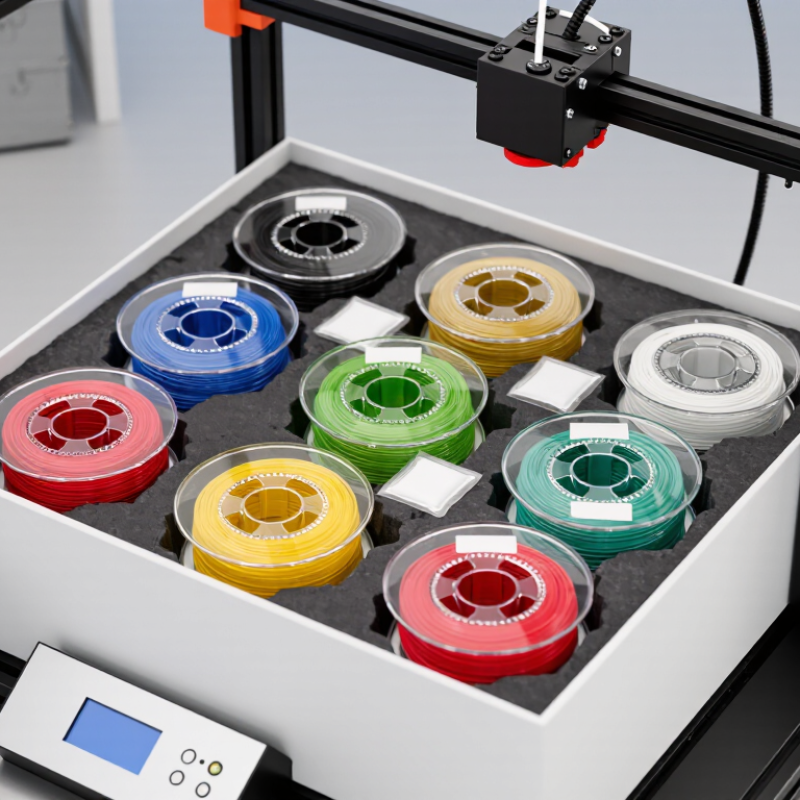
A useful comparison of ten ABS filament bundles starts with the colors you will actually use. Some packs offer several neutral shades, while others favor bright colors that make prototypes easier to distinguish. Check whether the listed colors match the product photos; screen settings can make a gray look almost blue. Small detail, real annoyance.
Specifications matter more than a large color count. Confirm filament diameter, stated tolerance, spool weight, and recommended printing temperature. Many printers use 1.75 mm filament, but some setups require 2.85 mm, so check before buying. ABS can shrink as it cools, making a stable enclosure helpful for larger parts. A bundle with consistent dimensions may feed more reliably than one with extra colors and vague specifications. Still, published tolerances do not guarantee identical results on every printer.
Value depends on usable material, not just the bundle price. Compare the cost per kilogram, then consider whether the spools are sealed and easy to store. Moisture exposure can affect printing, so packaging is worth noticing. For regular projects, a smaller range of dependable colors may be better than ten shades you rarely touch. I would treat unusually low prices cautiously, but price alone proves little. Print settings, storage, and machine condition all influence the final surface, so a fair comparison should separate bundle features from printer-dependent results.
This is a comparison of illustrative, generic bundle configurations—not a ranking of specific products or a claim that every configuration is currently sold. ABS specifications vary by formulation; check the filament maker’s technical data sheet and printer requirements before buying.
| Rank | Generic Bundle Configuration | Color Selection | Typical Bundle Size | Common ABS Printing Range | Key Material Considerations | Value Fit |
|---|---|---|---|---|---|---|
| 1 | Everyday Starter Set | Black, white, gray, blue, red | 5 spools × 1 kg | Nozzle: 220–250°C Bed: 90–110°C |
A practical selection of common colors. ABS generally benefits from a heated bed and a draft-controlled enclosure because uneven cooling can cause warping. | Good color variety for general-purpose projects |
| 2 | Neutral Color Set | Black, white, gray, natural | 4 spools × 1 kg | Nozzle: 220–250°C Bed: 90–110°C |
Neutral colors suit prototypes and functional parts. “Natural” usually means uncolored or lightly tinted filament; its appearance can vary by formulation. | Useful when neutral colors are used more often than bright colors |
| 3 | Bright Color Set | Red, orange, yellow, green, blue | 5 spools × 1 kg | Nozzle: 220–250°C Bed: 90–110°C |
Bright pigments may affect the final shade and surface appearance. Printing temperatures should follow the specific filament’s guidance. | Good for color-coded parts and visible models |
| 4 | Dark-Tone Set | Black, dark gray, navy, dark green | 4 spools × 1 kg | Nozzle: 220–250°C Bed: 90–110°C |
Dark colors can make layer lines less noticeable in some lighting. ABS can release fumes during printing, so use appropriate ventilation. | Suitable for enclosures, brackets, and other understated parts |
| 5 | Small-Quantity Trial Set | Four assorted colors | 4 spools × 250 g | Nozzle: 220–250°C Bed: 90–110°C |
Smaller spools reduce the amount of each color on hand. Confirm that spool dimensions and filament diameter match the printer or spool holder. | Lower material commitment for testing several colors |
| 6 | Monochrome Workshop Set | Black and white | 2 spools × 1 kg | Nozzle: 220–250°C Bed: 90–110°C |
A simple two-color selection for prototypes and functional prints. ABS has a glass-transition temperature around 105°C, with exact values depending on the formulation. | Focused choice when only basic colors are needed |
| 7 | Color-Coding Set | Red, yellow, blue, green, white, black | 6 spools × 500 g | Nozzle: 220–250°C Bed: 90–110°C |
Several smaller spools make it easier to assign colors to different parts or projects. Check spool width and winding compatibility. | Broad selection without committing to full-size spools |
| 8 | Large-Volume Single-Color Set | One chosen color | 4 spools × 1 kg | Nozzle: 220–250°C Bed: 90–110°C |
Multiple spools of one color can simplify repeat production. ABS shrinkage and warping depend on part geometry, cooling, printer setup, and formulation. | Potentially convenient for repeated prints in one color |
| 9 | Mixed Neutral-and-Bright Set | Black, white, gray, red, blue, yellow | 6 spools × 1 kg | Nozzle: 220–250°C Bed: 90–110°C |
Combines everyday neutrals with several bright options. ABS is generally less prone to moisture uptake than some hygroscopic filaments, but dry storage can still help maintain consistent printing. | Versatile selection for varied projects |
| 10 | Specialty-Finish Set | Assorted solid colors; finish varies by formulation | 3–5 spools; spool mass varies | Use the filament maker’s stated range | Finish labels such as matte or glossy are formulation-dependent and are not guaranteed by ABS alone. Verify diameter, spool mass, and technical specifications for each spool. | Best when finish or appearance matters more than a standard color mix |
ABS filament bundles are useful when you need spare material or several colors, but a bundle label cannot tell you how a part will perform. Check the technical sheet for tensile strength, test direction, and temperature. Results depend on print settings and specimen shape. A printed bracket is not a lab sample. I have seen two spools behave differently, even with similar settings.
Keep ABS dry and inspect each spool for tangled filament or damaged packaging. An enclosure helps hold a steady temperature and reduce drafts, which can limit corner lift on a wide, flat print. Watch the first layers closely. A slight gap at one corner can grow before the part finishes. Tensile data is useful for comparing materials, not a guarantee of real-world strength. Layer bonding, infill, and print orientation matter too.
Ventilation deserves equal attention. ABS printing can release fumes and particles, so use a well-ventilated workspace and follow the printer and filament maker’s safety guidance. An enclosure is not a ventilation system. If you add an exhaust or filtration setup, check that it moves air without cooling the print unevenly. That balance can be fiddly. Keep the printer away from living areas when practical, and do not rely on smell to judge air quality.
Add shipping to the price, then divide by the total net filament weight in kilograms. More spools do not always mean better value.
Compare the labeled net weight on each spool. Mixed spool sizes can make bundle comparisons less straightforward.
No. Check the stated tolerance and quality details. A caliper can spot an obvious mismatch, but one reading cannot verify a whole spool.
Uneven diameter may affect extrusion and flow. That can be frustrating, though printer settings and condition also play a part.
Only if you expect to use those colors. A smaller set of dependable shades may suit regular projects better.
Compare the listed colors with product photos, but remember that screen settings can shift how a shade looks. Small detail, real annoyance.
Check diameter, stated tolerance, spool weight, and recommended printing temperature. Also confirm whether your printer uses 1.75 mm or 2.85 mm filament.
ABS can shrink as it cools, so a stable enclosure may help with larger parts. A bundle may be poor value if your setup struggles with warping.
Sealed packaging and clean, dry storage can help protect filament from moisture exposure. Extra spools need space, too.
Not necessarily. Consider usable colors, clear weight labels, packaging, and your printer’s performance. Price alone proves little.
This guide explains the essentials of choosing an Abs Filament Bundle for reliable 3D printing. It covers ABS’s typical density of 1.04 g/cm³ and glass transition temperature of about 105°C, then compares bundles by spool count, 1.75 mm filament diameter, color selection, and cost per kilogram. The goal is to help readers weigh practical specifications and overall value rather than choosing by price alone.
The guide also outlines common ABS printing requirements, including a nozzle temperature of 220–250°C and a heated bed set to 90–110°C. It reviews how to interpret tensile data and match filament properties to a project, while highlighting the benefits of an enclosure for managing drafts and temperature changes. Finally, it emphasizes good ventilation and careful setup to support more consistent prints and a safer, more comfortable workspace.