Buying filament in bulk can lower per-spool costs, but the cheapest quote rarely tells the whole story. 3d Printer Filament Wholesale decisions affect print quality, production schedules, and how much material sits on your shelves. A carton of PLA may look like a bargain until colors vary between batches or damp spools cause stringing. Small details matter.
Before requesting prices, define your needs: material type, diameter, color range, monthly usage, and printer compatibility. Ask suppliers about tolerance specifications, batch identification, packaging, and current lead times. If possible, test sample spools using the nozzle, temperature, and print profile used in production. Keep notes. One clean test is useful, but it cannot guarantee that every future batch will behave identically.
Compare landed cost, not just unit price. Include freight, minimum order quantities, payment terms, damage procedures, and storage needs. Filament should arrive sealed and stay dry; a simple inventory rotation plan can help prevent waste. Check whether suppliers provide clear documentation and responsive technical support, especially when you change materials or increase order volume. I have seen buyers focus on discounts and overlook shelf space. It happens. Wholesale purchasing is not automatically better for every workshop. Start with a measured order, verify quality, then expand when demand and supplier performance justify it. There will still be trade-offs. That is normal.
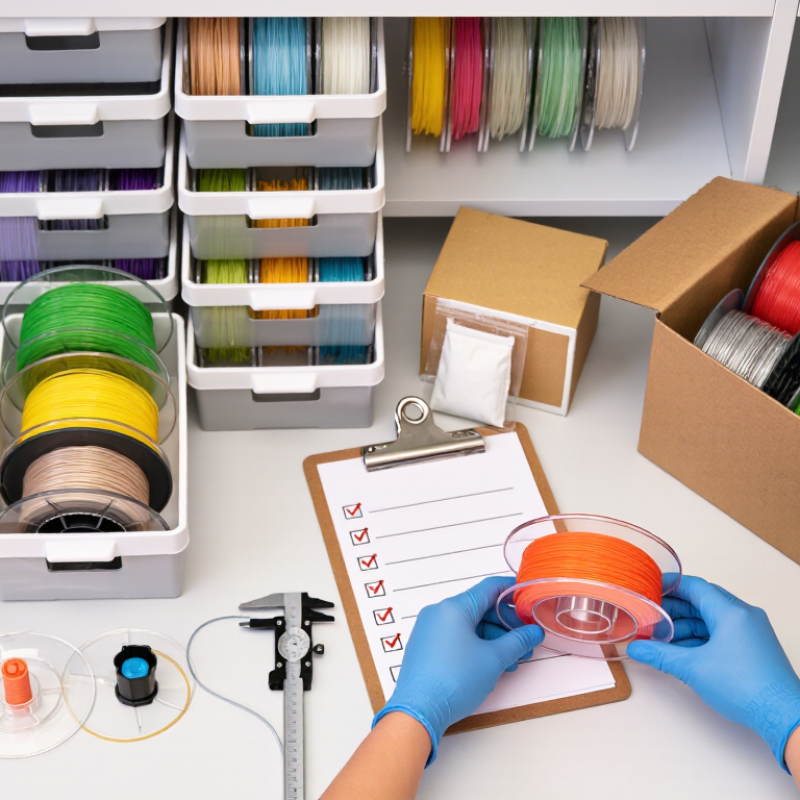
Before requesting wholesale quotes, define the exact filament mix: polymer, diameter, color, tolerance, and spool size. Separate routine materials from specialty colors; otherwise, a low unit price can leave slow-moving stock on the shelf. The Wohlers Report 2024 estimated that the global additive manufacturing industry generated $21.9 billion in 2023, up 11.1% year over year. That figure covers the wider industry, not filament sales, so it signals sector growth but cannot predict your own material demand.
Estimate volume from actual printer use. If six machines each consume about 0.7 kg per week, weekly demand is roughly 4.2 kg. With a four-week supplier lead time, that is 16.8 kg before adding a buffer; a 20% reserve brings the order to about 21 kg. Small batches help. Track failed prints, supports, purge waste, and seasonal projects for at least several weeks before scaling up. I would still treat the first estimate as provisional; print failures can distort it. Store a sample spool under the same conditions planned for bulk stock, then check feeding, dimensional consistency, and print quality before committing. Compare minimum order quantities and delivery schedules against available dry, sealed storage—not just the quoted price.
Estimate your order using monthly filament demand and a 25% buffer. This planning example assumes standard 1 kg spools; round up to whole spools when placing an order.
Planned purchase volume = monthly demand × 1.25. Adjust the buffer to match your supplier lead time, storage capacity, and actual usage.
When buying 3D printer filament wholesale, compare suppliers on consistency, not just the quoted price. Ask for a sample spool and check diameter with calipers at several points. Uneven filament can cause feeding problems, even when the label looks precise. Request written specifications for tolerances, net spool weight, and moisture-resistant packaging. Small details matter.
Material choice changes the real cost. PLA is often a practical option for general-purpose prints, while PETG may suit parts that need more toughness. ABS can require a controlled printing environment, so consider whether your equipment and workspace can handle it. Check whether the supplier can provide consistent colors and material data across production lots. I have found that a low-cost sample can be misleading. Test more than one spool if possible.
Compare minimum order quantities, price breaks, shipping fees, and replacement policies side by side. Calculate cost per usable kilogram, not merely cost per spool; empty spool weight varies. Ask how stock is stored and whether batches are traceable. A supplier who answers clearly is easier to evaluate. Still, no spreadsheet predicts every failed print. Leave room in your budget for testing, especially when switching materials or placing a large order.
Wholesale filament should be checked by lot, not just by color or price. Measure several points along a sample spool with a calibrated caliper, and compare the results with the supplier’s stated diameter tolerance. Then print a short test part. Watch for uneven extrusion, brittle snapping, rough surfaces, and stringing. Looks can mislead. A dry, sealed sample may behave differently from a spool left open in a humid warehouse.
Printer compatibility needs equally careful checking. Confirm the material’s recommended nozzle and bed temperatures, spool dimensions, and any enclosure requirements against your machines. ISO/ASTM 52903-1:2020 sets a framework for material-extrusion feedstock, but it does not replace machine-specific testing. Ask for a technical data sheet, safety data sheet, batch traceability, and relevant test certificates. Verify that each document names the material and production lot. Certifications depend on the intended application; a generic certificate is not proof of performance. Wohlers Associates reported that the additive manufacturing industry grew 11.1% to $20.035 billion in 2023 in its Wohlers Report 2024. That growth makes sourcing more consequential, but it does not guarantee consistent filament. I would still test a production sample before committing to a large order. One overlooked detail can waste a whole batch.
| Evaluation area | What to check | Useful reference or benchmark | Evidence to request |
|---|---|---|---|
| Filament diameter | Confirm the nominal diameter matches the printer’s extruder setup and check consistency along the spool. | Common nominal sizes are 1.75 mm and 2.85 mm. A supplier may specify a tolerance such as ±0.02 mm; confirm the actual specification rather than assuming it is universal. | Technical datasheet, stated tolerance, and measurements from a representative sample. |
| Roundness and surface | Look for oval sections, kinks, surface roughness, bubbles, or inconsistent winding that could interrupt feeding. | Inspect multiple points and measure across more than one axis; diameter alone may not reveal ovality or winding problems. | Sample spool, inspection method, and documented quality-control limits. |
| Material and print settings | Match the polymer to the intended use and verify the recommended nozzle and bed temperatures. | Typical starting ranges vary by formulation: PLA about 190–220°C, PETG about 220–250°C, and ABS about 230–260°C for the nozzle. Follow the supplier’s specific guidance. | Material datasheet, recommended settings, and a print sample made on a comparable printer. |
| Printer compatibility | Check filament diameter, maximum hotend temperature, extruder type, build-surface requirements, and enclosure needs. | ABS commonly benefits from a heated bed and an enclosure; flexible TPU can require a compatible, well-guided feed path. Printer limits and material formulations differ. | Compatibility matrix, sample spool dimensions, and a trial print on the target printer type. |
| Moisture control | Ask how filament is dried, sealed, and protected in storage and transit. Moisture can contribute to popping, bubbles, and poor surface finish. | No single moisture limit applies to every polymer; requirements depend on the material and supplier specification. Nylon and other moisture-sensitive materials need particular care. | Packaging description, drying or moisture-control process, and any applicable moisture test results. |
| Spool and packaging | Check spool width, hub diameter, winding, net filament weight, labeling, and protection from humidity and damage. | Spool dimensions and net weight are not universal. Compare them with the printer holder and storage or shipping requirements. | Dimensioned spool drawing, net-weight specification, packaging photos, and sample shipment. |
| Batch consistency | Compare color, diameter, print behavior, and packaging between samples and production lots. | Agree on measurable acceptance criteria before placing a large order; color appearance can vary between production batches. | Batch identification, inspection records, and an approved pre-production sample. |
| Safety and compliance documents | Check which regulations apply in the destination market and whether the documents cover the exact material and product. | A Safety Data Sheet (SDS) provides hazard and handling information. RoHS and REACH documentation may be relevant to market requirements; neither should be treated as a general print-quality guarantee. | Current SDS, applicable declarations or test reports, and product or material identification matching the order. |
| Claims for regulated uses | Do not assume a generic filament is suitable for food contact, medical use, or other regulated applications. | Suitability can depend on the formulation, additives, printing process, finished part, and applicable jurisdiction-specific rules. | Relevant test reports and compliance documentation for the intended application and finished product. |
| Wholesale terms and trial order | Confirm minimum order quantity, price breaks, lead time, payment terms, shipping method, and defect-resolution process. | Terms vary by supplier and destination. Validate a representative sample or small trial order before committing to a larger volume. | Written quotation, sample-order terms, delivery estimate, and documented returns or claims policy. |
Wholesale pricing is only one part of the real cost. Calculate filament, freight, insurance, duties where applicable, and receiving fees before comparing suppliers. For example, 100 spools at $18 each cost $1,800 before delivery. A $240 freight charge adds $2.40 per spool. The Wohlers Report 2024 estimated the global additive manufacturing industry reached $20.035 billion in 2023, showing why buyers should plan for reliable, repeatable supply—not just a low first-order price. Request carton dimensions and gross weight, then compare pallet freight quotes using the same shipment details.
Storage also affects usable inventory. Filament can absorb moisture, which may contribute to inconsistent extrusion, rough surfaces, or brittle prints. Keep cartons sealed, store them off concrete floors, and track opened spools separately. Measure shelf depth and height before ordering; 100 spools need more room than their packaging suggests once aisles and handling space are included. I still see storage estimates get too optimistic.
Tips: Calculate landed cost per usable spool, not per carton. Ask for lead times, packing details, and replacement terms in writing. Start with a smaller trial order if storage conditions or print quality are untested. Keep a simple log of humidity, stock age, and spool performance.
Before placing a wholesale order, write down the exact material, diameter, color, and tolerance you need. Ask the supplier how each batch is measured and packaged. Confirm spool dimensions, carton quantities, lead time, and what happens if goods arrive damaged. Small details matter. A sample order can reveal winding problems, inconsistent diameter, or moisture exposure before you commit to a full pallet. Store a few sample spools in your usual workspace and test them on the printers you actually use. A clean-looking sample is not enough.
Keep the purchase order, product specifications, and delivery records together. When the shipment arrives, inspect several cartons, not just the one on top. Measure filament at multiple points with a caliper, and note any tangles, crushed spools, or damp packaging. Then track print results across the first few production jobs, including clogs, surface defects, and failed prints. Compare those observations with the supplier’s stated specifications. One rough spool does not prove a supplier is unreliable, but repeated variation deserves a direct discussion. I once treated a late delivery as a one-off; later orders showed the estimate was too optimistic. Ask for a corrective action and a realistic schedule, then record whether performance improves.
Specify polymer, diameter, color, tolerance, and spool size. Separate routine materials from specialty colors to avoid slow-moving stock.
Track actual printer use, failed prints, supports, and purge waste for several weeks. Six printers using 0.7 kg each per week need about 4.2 kg weekly. With a four-week lead time and a 20% reserve, that is roughly 21 kg. Treat the estimate as provisional.
Measure the filament at several points with a calibrated caliper. Then print a small test part and check feeding, surface quality, stringing, and brittleness. Looks can mislead.
Compare recommended nozzle and bed temperatures with your machine settings. Check spool dimensions and enclosure needs, too. Test on your actual printers before placing a large order.
Ask for technical and safety data sheets, batch traceability, and relevant test certificates. Confirm that documents identify the exact material and production lot. A generic certificate may not prove performance.
Include filament, freight, insurance, applicable duties, and receiving fees. For example, $240 freight adds $2.40 to each spool in a 100-spool shipment priced at $18 per spool.
Keep cartons sealed and raised off concrete floors. Track opened spools separately, and record humidity, stock age, and print results. Storage estimates get optimistic.
Start small if storage conditions or print quality are untested. Check delivery timing, carton size, and replacement terms in writing. One early test can prevent a much larger waste.
Buying 3d Printer Filament Wholesale starts with understanding what your operation needs. Identify the materials, colors, filament diameters, and quality levels required, then estimate your regular and peak usage so you can choose a practical order volume. Compare multiple suppliers by reviewing their material options, pricing, minimum quantities, and ability to provide consistent stock. A low unit price is useful only if the filament performs reliably and suits your printers and intended applications.
Before ordering, check product specifications, sample quality, printer compatibility, and any relevant quality or safety certifications. Calculate the full cost, including shipping, taxes or fees where applicable, and the expense of storing the filament in suitable conditions. Once you have compared the options, place an order at a scale that fits your budget and storage capacity. Track delivery, inspect the filament on arrival, and evaluate print results, packaging, communication, and consistency. This process helps you make informed purchasing decisions and assess whether a supplier is dependable for future orders.